
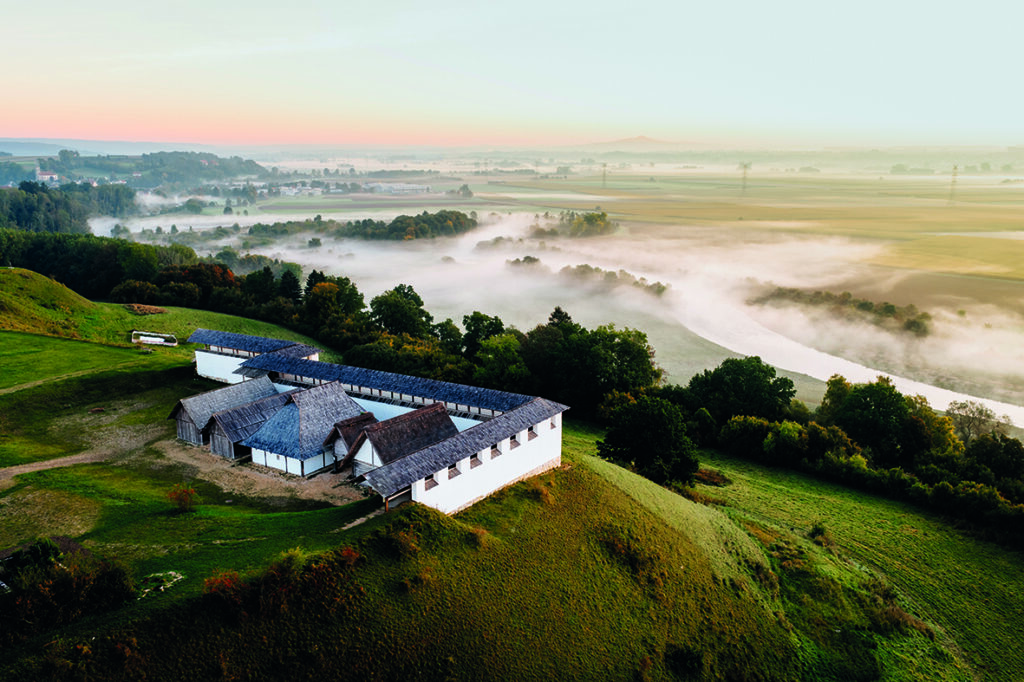
There are many legends and fairy tales about the Celts – yet hardly anyone knows where their origins really lie. An unassuming hill overlooking the Danube in the district of Sigmaringen provides a surprising answer: here, on the Heuneburg, stood the oldest city north of the Alps 2,600 years ago – and to this day
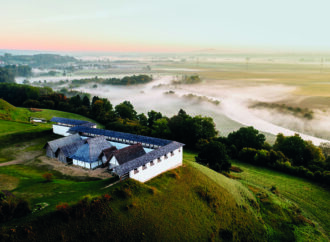
There are many legends and fairy tales about the Celts – yet hardly anyone knows where their origins really lie. An unassuming hill overlooking the Danube in the district of Sigmaringen provides a surprising answer: here, on the Heuneburg, stood the oldest city north of the Alps 2,600 years ago – and to this day it revolutionises our image of an advanced civilisation that shaped Europe long before Rome.
A hill with a long memory
The distinctive ridge along the upper reaches of the Danube in the Hundersingen district of the municipality of Herbertingen, about 14 kilometers east of the Baden-Württemberg town of Sigmaringen, has long been known. In the Middle Ages, people called it the “Heidenstadt” (Heathens’ Town) – a name that suggests they knew something had once existed here. The first antiquarian descriptions date back to the 19th century. But systematic scientific research did not begin until after World War II. From 1950 to 1979, Wolfgang Kimmig of the Württemberg State Museum in Stuttgart excavated the site and uncovered structures that no one had expected: fortification ramparts, building foundations, craft workshops—and a wall that continues to surprise researchers to this day.
This wall, dating from the 6th century B.C., was constructed of air-dried mud bricks, featured bastions, and was built using a construction technique previously known only in the Mediterranean region. Someone in this Celtic settlement north of the Alps had not only been familiar with Mediterranean architecture. They had copied it, refined it, and put it into practice. This was no coincidence and no trade – it was knowledge transfer at the highest level.
A city – bigger than expected
What Kimmig had unearthed was impressive. But it was only a fraction of the truth. Beginning in 2005, Prof. Dr. Dirk Krausse, head of department at the Baden-Württemberg State Office for the Preservation of Historical Monuments, employed state-of-the-art survey methods: geomagnetics, aerial archaeology, and targeted excavations. The result was a paradigm shift. In front of the fortifications of the actual castle hill lay a vast outer settlement—structured, densely populated, and covering over 100 hectares. This was not a collection of huts. It was a city.
“Archaeologically, urban structures at Heuneburg can be traced back to around 600 B.C.,” says Krausse. “And it is very likely identical to the first settlement north of the Alps mentioned in ancient written sources – the Polis Pyrene cited by Herodotus.” The father of historiography may therefore have known Heuneburg. How many people lived here? Krausse is cautious with numbers: “We estimate that around 3,000 to 5,000 people lived in the entire city, including the outer settlement, by the middle of the 6th century BC. But if you factor in the associated settlements in the surrounding area, the population of this community reaches five figures.” He expressly emphasizes: This is based on theoretical model calculations. But even as an estimate, this figure is extraordinary for the Iron Age.
Gold from the black soil
Krausse remembers exactly the moment that moved him the most. It was the excavation of the tomb of the so-called “Bettelbühl Princess”—one of the most magnificent princely tombs in the vicinity of Heuneburg. “When one of the large, beautiful brooches made of pure gold suddenly emerged from the black soil,” he says, “you never forget that.” Such finds are more than just jewelry. They are evidence. They attest to a society with an extreme hierarchy, with an elite that accumulated wealth, organized long-distance trade, and presented itself in a splendor that we long knew only from the Mediterranean region. These people were not isolated tribal warriors. They were part of a vast trade network that connected the Celtic elite with the ancient world.
A lifetime of research isn’t enough
What makes Heuneburg so special compared to other early Celtic princely seats? Krausse, who has been fascinated by this site since his first field trip as a student in Göttingen in 1984, offers a surprisingly honest answer: “Heuneburg is by far the best-studied early Celtic princely seat. But that is precisely why new questions keep arising. We understand it better than any other – but we are far from having fully explored it.” What else lies buried? Two-thirds of the castle hill remain unexcavated. The cultural layers are up to three meters thick in places. Krausse suspects there may be wells, perhaps a sanctuary or a temple—neither of which has been found so far. Below the site, directly on the Danube, there could be a harbor. There are still many unanswered questions. “An archaeologist’s life is too short,” Krausse says simply. “It will take generations of archaeologists.”
2,500 years isn’t that long
What can we learn today from the Celts of Heuneburg? Krausse resists the obvious temptation to exploit the past for current political narratives. Instead, he makes a seemingly simple yet profound observation: “2,500 years have passed since the end of Heuneburg, during which time people have lived in southwestern Germany. If we look 2,500 years ahead from today, we are talking about the year 4526 AD. In light of looming tipping points and Earth Overshoot Days occurring earlier and earlier, that is a figure that seems downright utopian.”
People have managed for millennia without many things that seem indispensable to us today. This realization, he says, may perhaps contribute to a shift in thinking.
What does Krausse personally hope for the future of Heuneburg? He smiles. “The discovery of an inscription identifying Heuneburg as Polis Pyrene wouldn’t be bad. Inclusion on the UNESCO World Heritage List. And lots of visitors.” Three wishes that show this is about more than just archaeology. Heuneburg is the oldest and most significant testament to urban civilization in the territory of present-day Baden-Württemberg—a heritage that secures the state a firm place in European early history and whose scientific potential, according to experts, justifies a UNESCO World Heritage nomination.
Mirella Sidro,
Sarajevo
Heuneburg – City of Pyrene
www.heuneburg-keltenstadt.de
Hours: Tue–Sun, holidays, 10:00 a.m.–5:00 p.m.