
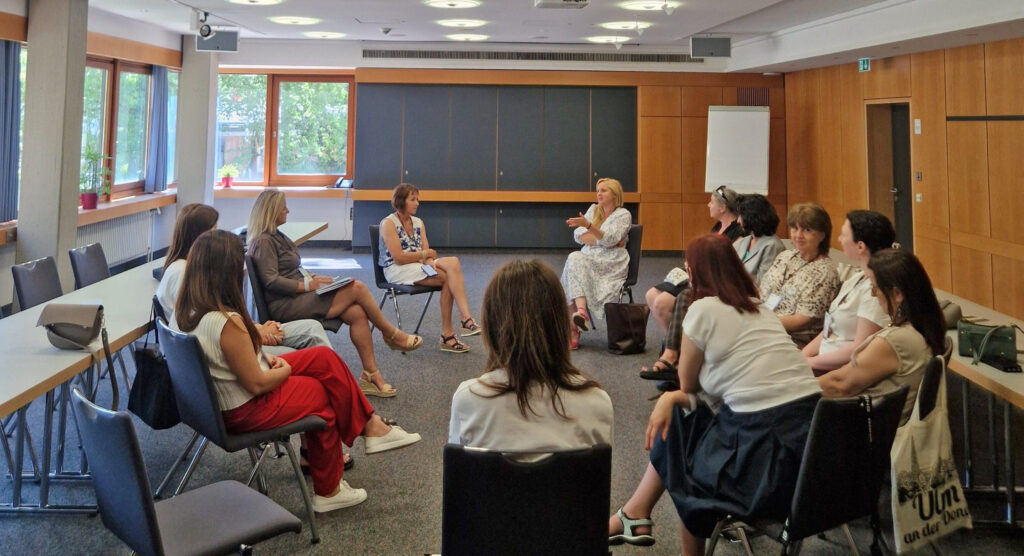
At the 2026 International Danube Festival in Ulm, women from the Danube Swabian region and Ukraine came together with opinion leaders from Serbia, Austria and Germany for a two-day workshop on combating fake news and online hate, held as part of a conference on democracy. Between media training sessions, a shared dinner in the garden
At the 2026 International Danube Festival in Ulm, women from the Danube Swabian region and Ukraine came together with opinion leaders from Serbia, Austria and Germany for a two-day workshop on combating fake news and online hate, held as part of a conference on democracy. Between media training sessions, a shared dinner in the garden and a specialist conference attended by 150 participants, one thing became clear: Democracy in the Danube region thrives on personal exchange – and needs it more urgently than ever.
The scent of the International Danube Festival is already in the air, but this morning, in the Verschwörhaus, women from five countries are sitting together and discussing digital powerlessness – and how to overcome it.
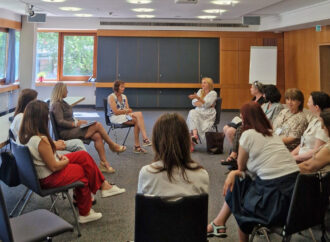
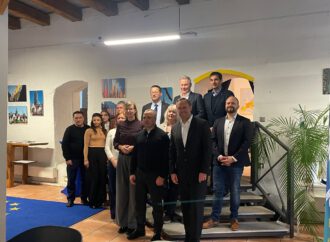
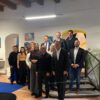
“Women Strengthen Democracy through Critical and Proactive Media Use” is the title of the workshop organised by Danube-Networkers for Europe (DANET) e.V., with funding from the Baden-Württemberg Foundation as part of the Perspektive Donau programme. The focus is on Danube Swabian and Ukrainian women coming together – supported by female influencers from Serbia, Austria and Germany. Moderator Sabine Geller, editor-in-chief of the European magazine *danube connects*, guides participants through a day that has little to do with dry theory: journalist Marie Claire Hildebrandt dissects fake news and disinformation using concrete examples, whilst Christiana Pordes Weidel, chair of *The World of NGOs* in Vienna, speaks openly about online hate directed at women.
Agnes Sebestyén, Managing Director of the Danube Swabian Cultural Foundation in Ulm, will present funding opportunities for cross-border, cultural and civil society projects. And Gabriele Flemming from ILEU e.V., the Institute for Virtual and Real Learning in Adult Education in Ulm, will demonstrate how Perplexity, ChatGPT and UmfrageOnline can be put to practical use for research, collaboration and project communication – AI tools as resources for your own project work.
Following the presentations, parallel working groups will explore the topic in greater depth – ranging from AI tools for research and participation, through reflections on female identity in different European societies, to the use of AI in project applications.
The evening is spent in the garden: homemade Kässpätzle with fried onions, hearty home-cooked food, accompanied by a quiz about the Danube and its region. Amidst laughter and guesswork, it quickly becomes clear just how much shared history binds the Danube region together.
On Friday, the gathering expands to take centre stage: around 150 participants from all the Danube countries are attending the symposium ‘Democracy needs us all’, organised by Ileu e.V. and hosted by Carmen Stadelhofer. Stadelhofer is chair of two NGOs that have long been committed to fostering contacts, cooperation and networking amongst civil society organisations in the Danube region: ILEU e.V. and Danet e.V. Founded in 2014, Danet e.V. is a close partner of Ileu e.V., which is already hosting the 10th partnership meeting of the informal educational network Danube-Networkers in Ulm – a network that has itself been in existence since 2008. For years, both organisations have been working together to foster contacts, cooperation and networking among civil society organisations in the Danube region.
Under the motto ‘Democracy needs all of us’, discussions took place at a diverse range of themed tables, with AI providing simultaneous translation into two languages. The mayors of Ulm and Neu-Ulm were in attendance, as were representatives from foundations and the EU Strategy for the Danube Region. In the afternoon, the previous day’s findings were explored in greater depth during a round-table discussion on women in Europe, self-image, identity and home.
Conclusion: the realisation that networking cannot be replaced by screens. Sometimes, a plate of Kässpätzle in the garden is all it takes. The joint visit to the International Danube Festival, which takes place only every two years, brought the group even closer together: this event brings the entire Danube region together.
Mirella Sidro,
Sarajevo