
It all began with an emotion: a few women gathered on the riverbank to bid farewell to a friend and scatter his ashes. We asked Danube to carry him to the sea – or perhaps to let him become a drop that falls elsewhere and gives life. We entrusted him to Danube, but we also
It all began with an emotion: a few women gathered on the riverbank to bid farewell to a friend and scatter his ashes. We asked Danube to carry him to the sea – or perhaps to let him become a drop that falls elsewhere and gives life. We entrusted him to Danube, but we also entrusted to her our memories and our love for him. A being who knows and who cares.
I am a researcher who seeks to discover how we relate to the world, what communication with beings other than humans might look, sound, or feel like. I chose the river Danube as the site of my research, or rather, Danube chose me.
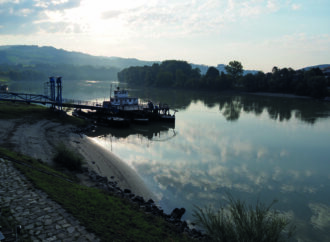
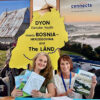
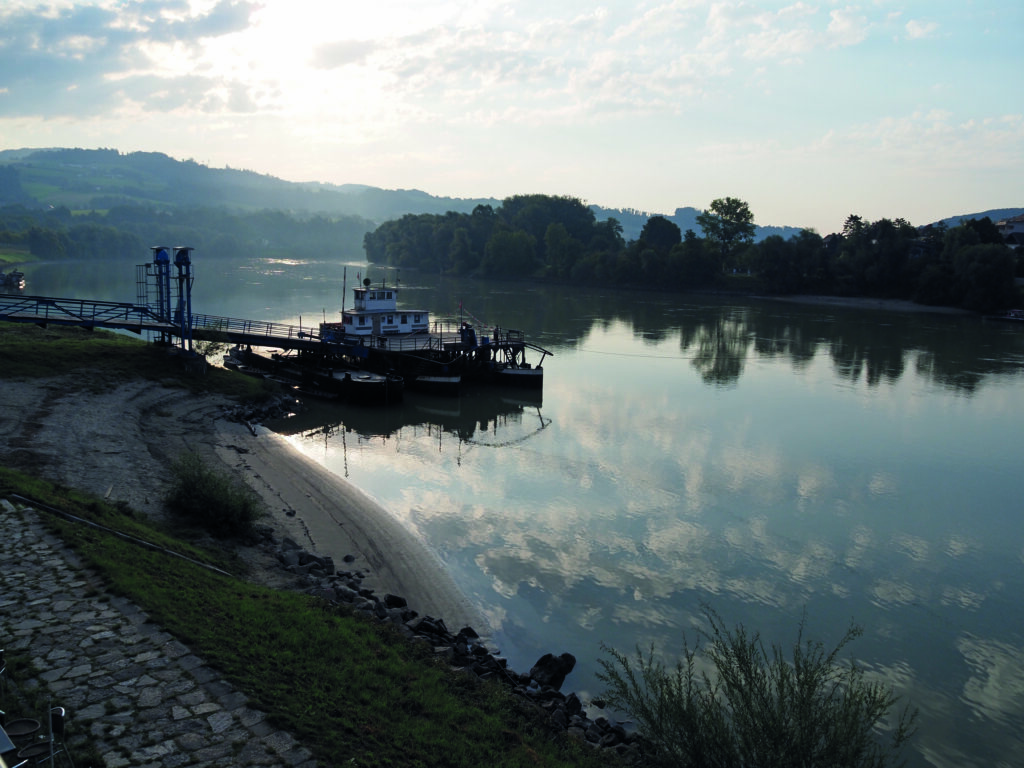
Between September 2024 and November 2025, I lived and traveled along Danube’s entire course – from Donaueschingen in the Black Forest to its mouth at the Black Sea. I sat, listened, recorded: I attuned; I walked and crossed national borders, bridges, and dams – boundaries mostly created by humans. And I spoke with people, curious to learn how they related to these waters and how the river communicated with amd through them.
One of the new friends I made shared how she wouldn’t be in this world were it not for Danube as her parents had met thanks to the river. She had become so intemately familiar with these waters that now she was able to recognize their scent anywhere: a musty, earthy fragrance with a distinctly plant-like quality. It smells, she assured me, “of movement, not of stagnant water.” A neighbor recalled how her aging mother whose memory was fading, would ask to be taken for walks along the banks of the Danube. It is a sense of familiarity, connection, and love for a place that transcends linear time, engaging our senses, our emotions, and our very sense of identity.
Both of these accounts speak to how these flowing waters and their river-scapes take on a meaning that challenges the conventional usage of the word “nature”, typically defined as something external to us, a place we might simply go to visit.
These deep-green waters, their faint earthy scent, the way they move and create sound on a specific bend – all these become part of who we are: physically, emotionally, and spiritually.
We are nature; we are the Danube; and the Danube is us. It is an exchange.
This holds especially true for those who live by Danube’s Delta. A fisherperson and guide I spoke to, admitted that he cannot imagine his own identity without that of the Delta: they are inseparable.
People who work close to, with and for the river in organizations such as the Danube Parks, may perceive the engineered structures and bank reinforcements lining Danube as a corset. One of them shared his dream of seeing a free-flowing river and asked me: “If you were stuck in such a corset, would you feel free?” I thought of the concrete and stones that constrain these waters, of straight lines, locks, and dams and the answer came immediately: No, of course I wouldn’t feel free.
Why, then, should we imagine that such a majestic river might feel any different? Or any river at all?
What would happen if we were to conduct a thought experiment:
What if we humans were not the only sentient, living beings on this planet? What if we were to open ourselves to the idea that bodies of water are living, communicative beings? Not that water speaks in human language, but rather that it communicates in a manner distinct from our own, yet is no less real and alive: through our senses, memories, emotional bonds, dreams, and encounters.
As I journeyed alongside Danube, I often dreamt of water. I also sat, listened, and attuned, relating to the waters not as an object, but as a companion in my research.
If we were to allow ourselves to think in this way, what would a harmonious coexistence with all other living beings look like?
What would a culture of mutual recognition and respect mean in practice?
What kind of politics and policies would we need?
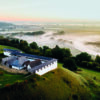
When I reached Sfântu Gheorghe at the Danube’s Delta I listened to what she was showing me and reflected on what this journey had meant. As I stood where her waters meet the sea, I did not perceive this as the river’s end but as a shift, a transition and a continuation.
Danube was herself, yet was no longer the same – and perhaps, neither was I.
As a European woman raised in a culture of dualism, exploitation and extraction, I had begun to connect with rivers – and through them to forests and all creatures – in a different way. An awareness was seeping in that there might be alternative ways of being and that the world is not defined by separation, but rather by a kaleidoscopic pluriverse of perspectives and modes of existence. And one of these is the being of water bodies, such as Danube.
As she became the sea, I realized that I was becoming rivered.
Chiara Muzzi,
London
About Chiara Muzzi
I am a PhD researcher at Loughborough University London, exploring a question that, at first glance, seems simple yet changes everything: What if rivers were not merely resources or landscapes, but living, communicative beings? Between September 2024 and November 2025, I travelled along the Danube, traversing six countries, wandering through layers of time, and learning from people who live in relationship with these waters: fishers who cannot imagine their identity without the Delta; conservationists who dream of free-flowing rivers; and elders who remember crossingfrozen waters to get to school.
My research project, “Becoming Rivered,” develops a river-led approach to understanding how we might communicate with and listen to the more-than-human world.