

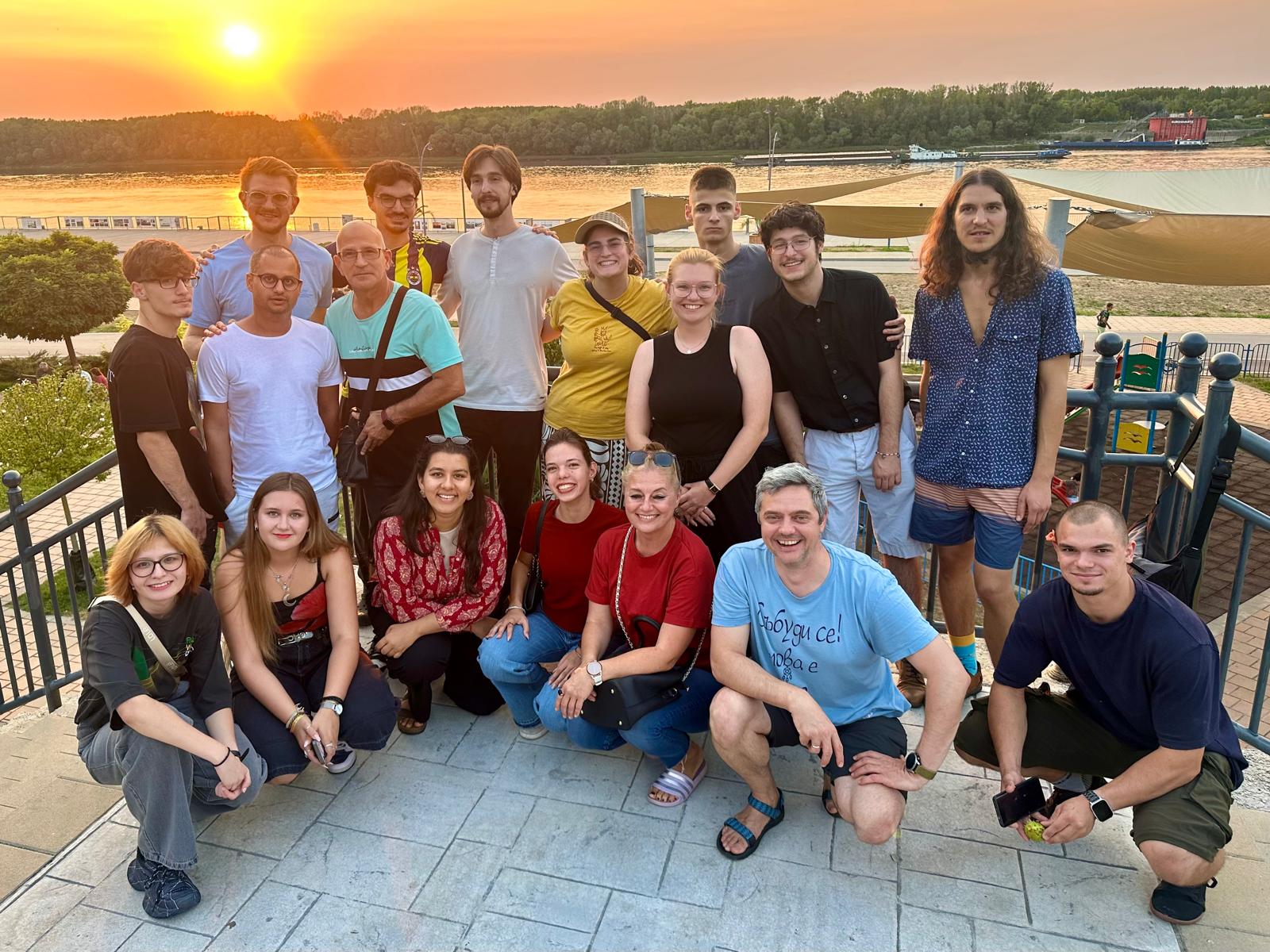
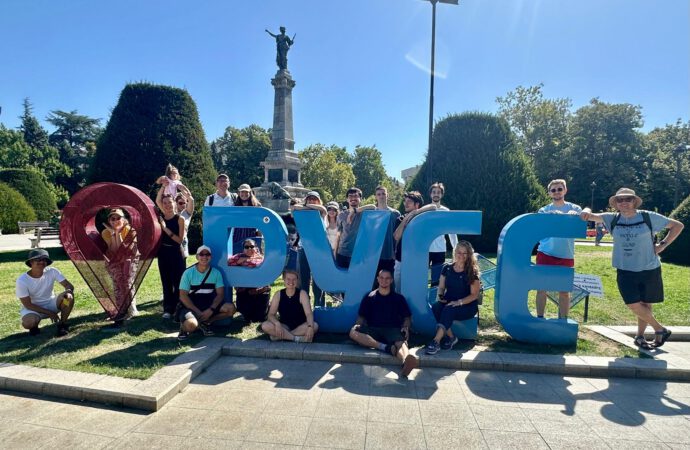
21 young people from five Danube countries, six days between Ruse, Belene and Svishtov, a finished work plan up to 2030: the second Boot Camp of the Danube Youth Organisations Network has shown that youth participation in the Danube Region is no longer just a declaration of intent. 21 young people from five Danube countries,
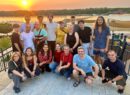
21 young people from five Danube countries, six days between Ruse, Belene and Svishtov, a finished work plan up to 2030: the second Boot Camp of the Danube Youth Organisations Network has shown that youth participation in the Danube Region is no longer just a declaration of intent.
21 young people from five Danube countries, six days between Ruse, Belene and Svishtov, a finished work plan up to 2030: the second Boot Camp of the Danube Youth Organisations Network has shown that youth participation in the Danube Region is no longer just a declaration of intent.
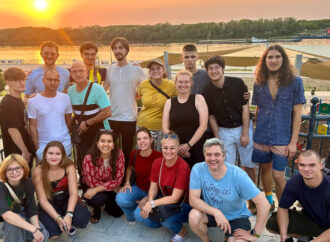
Anyone who wants to know whether a European strategy is actually reaching young people should look not only at conferences, but into a youth centre in Svishtov. There, in September, 21 participants from Germany, Bulgaria, Romania, Bosnia and Herzegovina and Ukraine sat in front of large sheets of paper and answered a question that is rarely put so directly in Brussels documents: what is our network actually supposed to be?
The second DYON Boot Camp took place in Bulgaria from 9 to 15 September 2026, following its premiere in Bosnia and Herzegovina in 2025. The change of venue follows a clear logic: the host country is always the one holding the EUSDR Presidency. In 2025 that was Bosnia and Herzegovina, in 2026 it is Bulgaria, and in 2027 Croatia takes over. The Boot Camp, in other words, travels with this responsibility.
Back to the Source
To understand the origins of the DYON story, you have to go back to the source. In 2011, the EU Strategy for the Danube Region (EUSDR) was officially launched in the Danube’s country of origin. In Baden-Württemberg, the new Green Minister-President Winfried Kretschmann was just forming his government. He anchored the EUSDR in his policies, and everyone set out to carry the strategy from the civil society of prosperous Baden-Württemberg all the way to the young democracies at the mouth of the Danube.
This image still sustains the commitment today: a majestic, cross-border river with a modest source high in the Black Forest and its mouth in the Black Sea, linking nine EU Member States and five candidate countries. In May 2026, the Danube Region Strategy was once again firmly anchored in the coalition agreement of the new state government.
The EUSDR has now turned 15, and one key insight from its governance is this: the strategy needs fresh water. New ideas and young people who are passionate about transnational cooperation, because that is precisely the essence of the EUSDR.
As a tributary to this process, the State of Baden-Württemberg approved two major projects to develop a Danube Youth Network (DJN), which ran from 2019 until the end of 2022. Then something happened that also happens to the Danube itself: between Immendingen and Möhringen, on an average of 155 days a year, the river seeps away completely into the limestone, and you can walk through its bed without getting your feet wet. No further funding was approved for the development of the youth network. But that did not mean it had disappeared: the Danube’s water re-emerges twelve kilometres further on at the Aachtopf spring. Here, too, a smaller tributary was found, in the DYON project.
At the same time, the Danube Strategy Point (DSP) in Vienna, the central governance body of the EUSDR, was mandated by the 14 National Coordinators to anchor youth participation in the strategy. Just as the Brigach and the Breg join to bring the Danube into being, the EUSDR’s official youth participation has since stood on two legs: a Danube Youth Council (DYC) and a network of organisations, the DYON.
A Story with a Break
One of the key players in this process is Stefan Barth, Managing Director of the Agapedia Foundation in Stuttgart, co-initiator of DYON and today its Single Point of Contact. On the second evening in Svishtov, he told the story of how individual projects grew into a network, under the title “DYN to DYON – A Living Story of Youth Participation”. The starting point lies with Agapedia, founded by Jürgen Klinsmann in 1995 and committed ever since to supporting children in Baden-Württemberg and Romania. Since 2001, the foundation has also been active in Bulgaria and the Republic of Moldova, and since 2017 in Georgia as well.
In 2013, the Danube dimension was added under the motto “Move – Meet – Make a Difference”. Between 2019 and 2022, a core group of NGOs from Bulgaria, Germany, Croatia, Romania and Serbia sustained the Danube Youth Network: Stiftung Liebenau, ABLE, Breza, Re-Act, Supernatural, the Federation of Social NGOs in Transylvania and Agapedia itself. This gave rise to formats with real reach: the “Friends of the Danube” youth camps for 15- to 30-year-olds, the “Youth and Cities” series in Ellwangen with six events a year and around 50 participants each, the “Shoot by Youth” video competition with 14 teams from six countries in 2021 alone, as well as the Danube Participation Days, organised together with the Danube Civil Society Forum.
Then, in Barth’s own words, came a “Frustration Time”. Commitment without a sustainable structure runs dry. The consequence was a fresh start. In 2024, under the coordination of the Austrian EUSDR Presidency, the Danube Youth Organisations Network was founded – an open network that now comprises around 50 youth organisations.
The structure is deliberately lean: the Danube Strategy Point, with Cristina Cuc, maintains the link to the strategy; a Single Point of Contact, Stefan Barth, pulls the threads together; and a Steering Group and thematic working groups connect the member organisations. In parallel, the Danube Youth Council enables young people to take part in the work of the individual Priority Areas (PAs) of the EUSDR. One graphic sums up the division of labour: DYON stands for broad, local, bottom-up civil society participation, the DYC for representation in the governing bodies. Together they form #DanubeYouth, the future vision for the network of youth participation in the EUSDR as a whole.
What Happened in Bulgaria
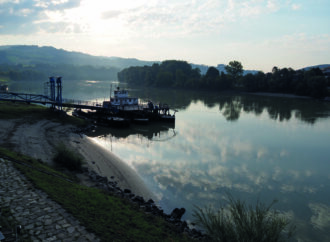
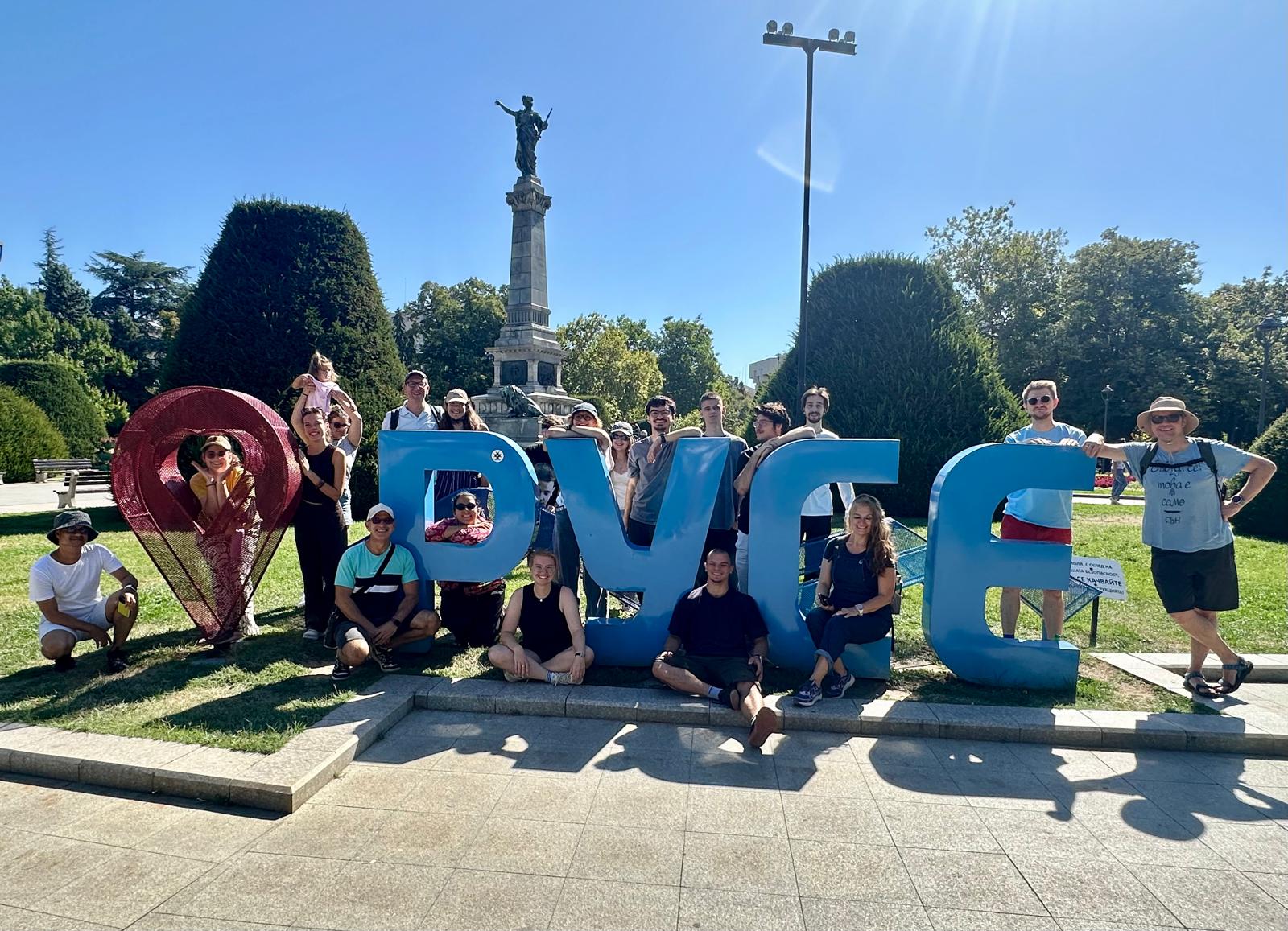
Organisiert wurde das Boot Camp von den bulgarischen NGO’s Re-Act unter Leitung von Lyuben Georgiev und Agapedia unter Leitung von Ivan Ivanov. The programme of DYON Bulgaria combined concrete local knowledge with theoretical working phases. It began in Ruse, Bulgaria’s largest Danube city, known as “Little Vienna” because of its façades, and whose history itself offers a lesson in civic engagement: in the late 1980s, women here protested against cross-border air pollution from Giurgiu in Romania, a protest regarded as one of the harbingers of political change. The environmental movement gave rise to the first open opposition in communist-ruled Bulgaria: in April 1989, the citizens’ movement Ecoglasnost was founded, and its demonstrations helped force party leader Todor Zhivkov to resign on 10 November 1989, one day after the fall of the Berlin Wall, after 35 years in power. A year later, Bulgaria held its first free elections since the Second World War.
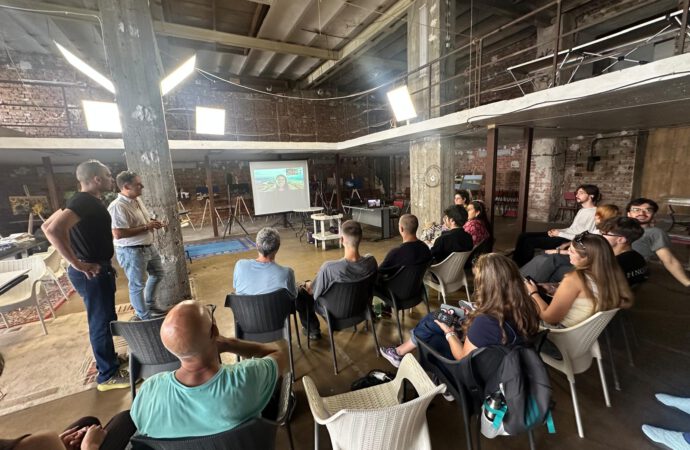
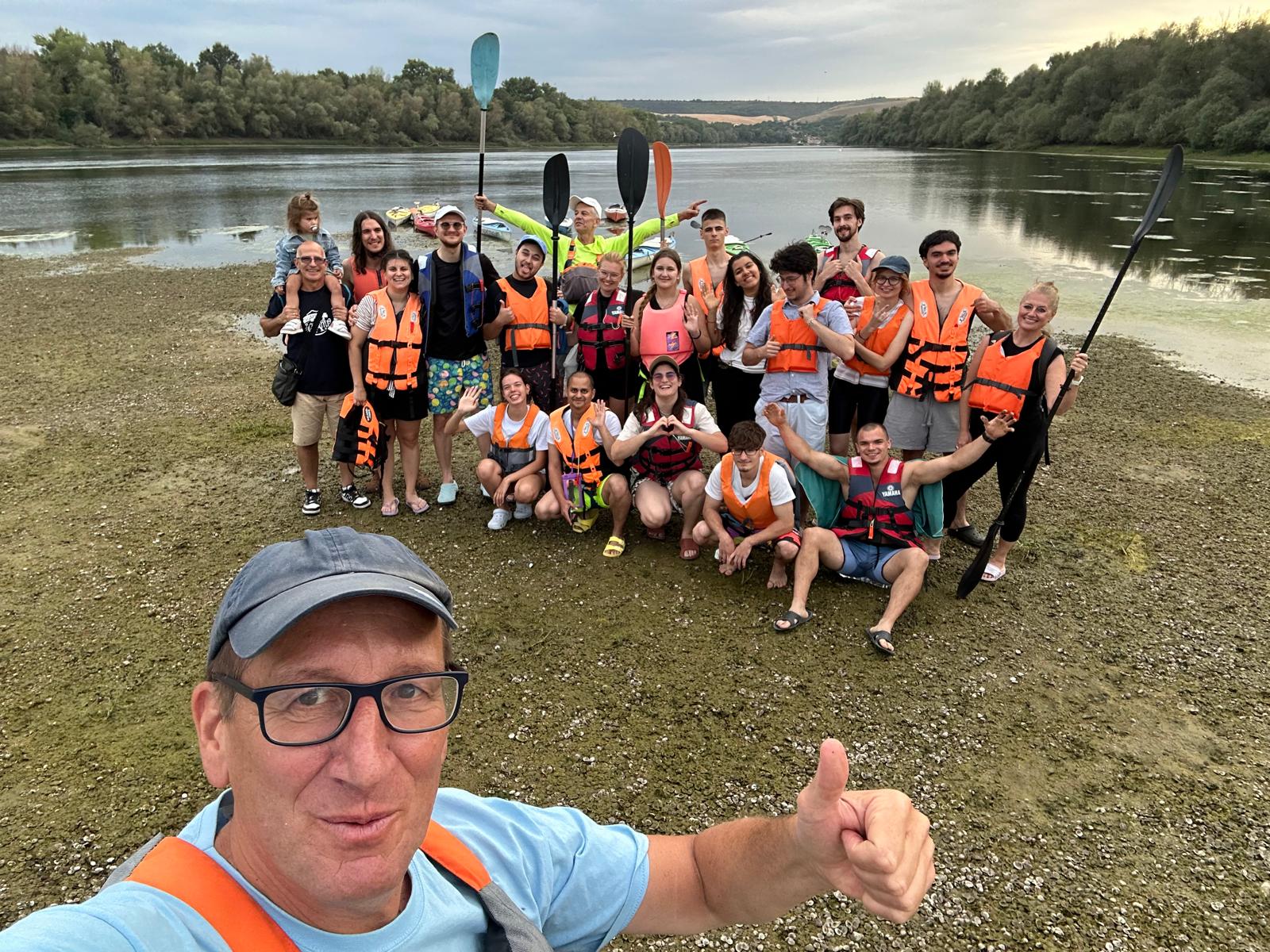
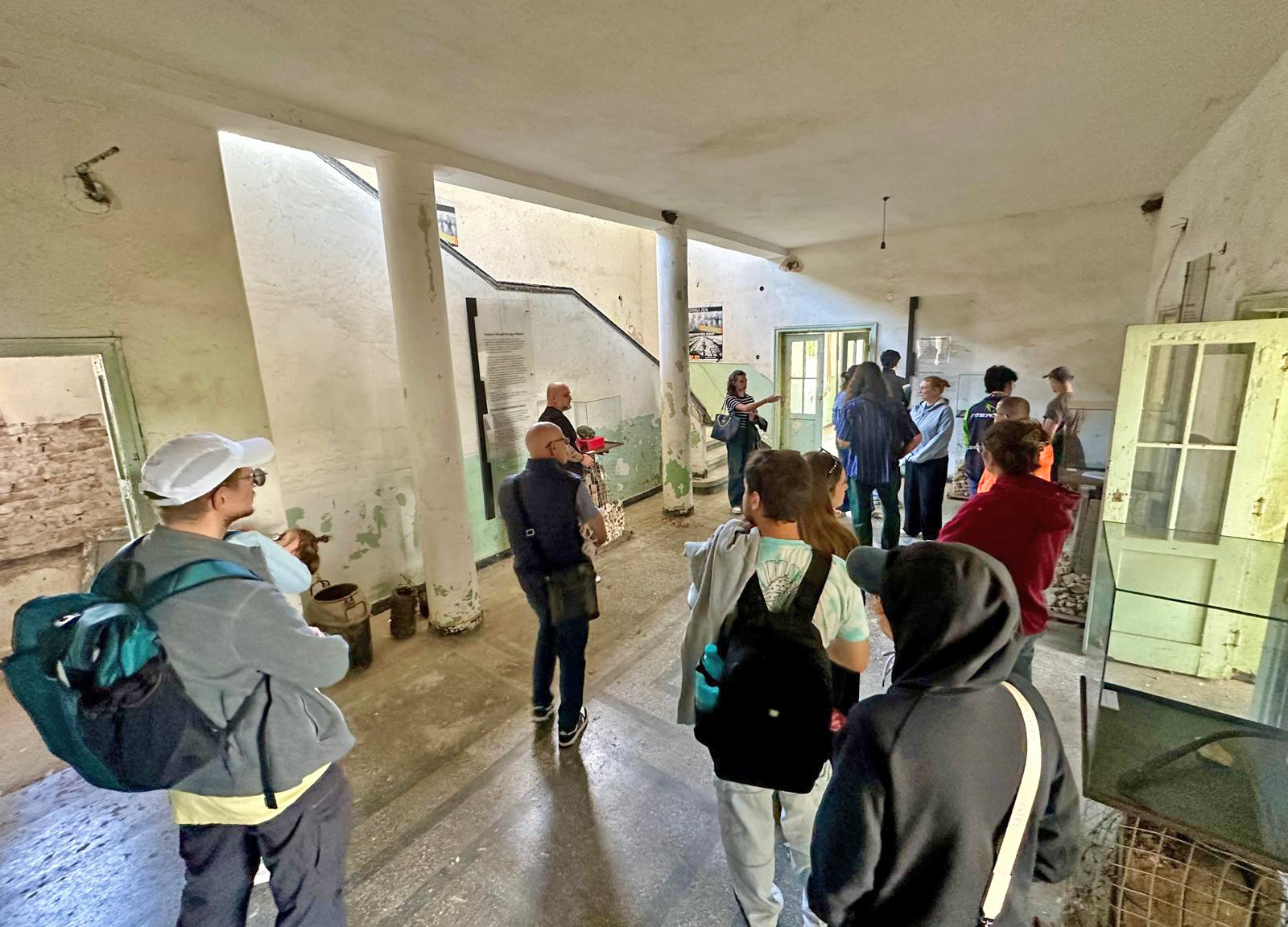
The second day led via the medieval rock-hewn churches of Ivanovo to Svishtov, the group’s base. The third day’s agenda featured the working session “Why do we need DYON?” at the Svishtov youth centre, followed by a kayak tour on the Danube in the afternoon. The fourth day was devoted to the island of Persin near Belene. From 1949 to 1987, it was home to the longest-running camp in communist Bulgaria; more than 15,000 people were interned there without trial, without charge and without a fixed term of detention. Today the island is part of Persina Nature Park. For a group discussing European cooperation, this place is an argument in itself.
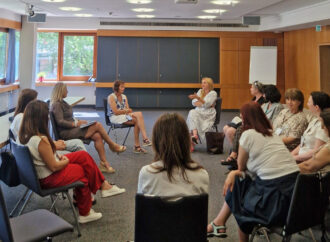
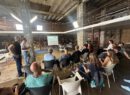
The fifth day at the youth centre in Svishtov was dedicated to the future: participants fine-tuned DYON’s priorities, roadmaps and responsibility tables.
PA8 Comes to the Youth Centre
The camp’s most important institutional step can be pinned down to one person. Mohini Sharma came on behalf of Priority Area 8 – Competitiveness of Enterprises, jointly coordinated by the Baden-Württemberg Ministry of Economic Affairs and the Croatian Ministry of Economy – with an informative talk entitled “From Strategy to Action – How can Young people shape cooperation in the Danube Region?”, which the young participants received with gratitude. An EUSDR Priority Area sending a representative to a youth centre on the lower Danube: this is proof that DYON is no longer a satellite, but an integral part of the strategy.
The EUSDR divides its work into twelve Priority Areas, ranging from waterways, rail and air transport, through energy, culture and tourism, water quality, environmental risks and biodiversity, to the knowledge society, competitiveness, education, security and institutional cooperation. This division is not a bureaucratic reflex but a practical necessity: a river that flows through ten countries brings flood protection, skills shortages and navigability with it all at once, and each of these issues needs different experts around the table.
Rather than lecturing, Sharma worked with activating methods: conversations in pairs, polls, open questions. In terms of content, she moved from the four pillars and twelve Priority Areas to the concrete work of PA8 in the fields of business start-ups, innovation and technology transfer, with working groups on the circular economy, artificial intelligence, digitalisation and women founders. Projects such as DRWO4.0, involving partners from eleven Danube countries, made it visible how a network turns into a result.
The decisive point was a sentence you rarely hear put this way: for candidate countries, European integration already begins here, through participation in these networks, long before accession. For young people from Bosnia and Herzegovina or Ukraine, this is practical information, not an empty phrase. Her four steps to getting involved: show up, bring an idea, look for partners, ask for directions.
Strategy Explained, in the House of the Canettis
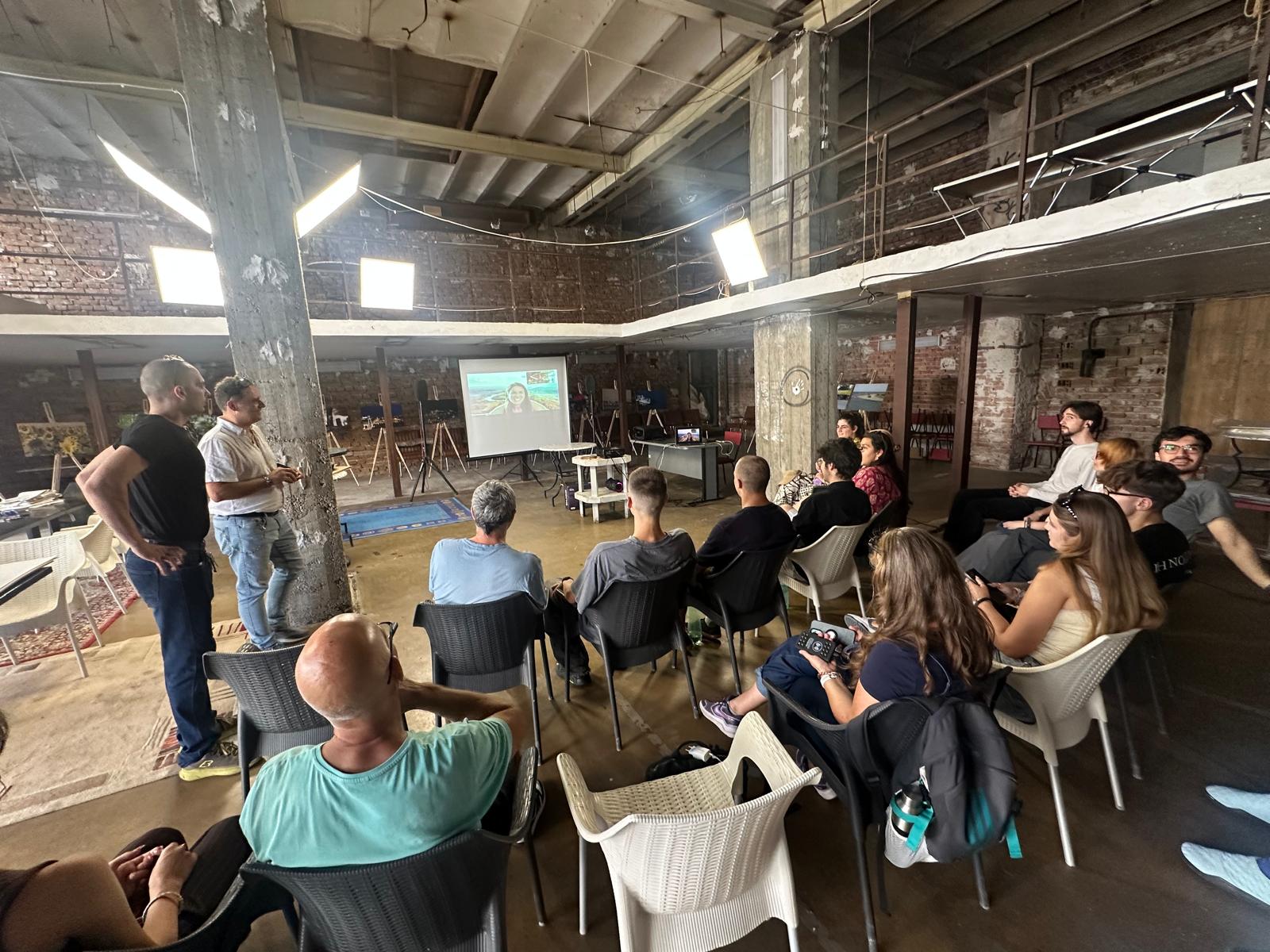
The Danube Strategy Point laid the groundwork on the first day. In an online session, Katharina Schmidt and Cristina Cuc explained how the EU Strategy for the Danube Region works: 14 countries on an equal footing, EU members and candidate countries alike, four pillars, twelve Priority Areas, and National Coordinators in every country.
The venue for the session was well chosen: the former trading house of the Canetti family in Ruse, the home of the grandparents of Nobel laureate in literature Elias Canetti, and today an exhibition space. Fittingly, the participants then mapped their own connections along the river in exercises such as the Human Danube Map and Identity Bingo. One insight from the discussion is something the strategy should take seriously: there is no shortage of youth organisations. The hard part is reaching young people themselves.
What Young People Want: DYON 2030
The working sessions delivered the substance. On three posters, the groups completed the sentence “DYON should…” in four fields: connect, strengthen, create, avoid. The results were strikingly consistent.
They want to CONNECT young people with experts, authorities, municipalities and funding opportunities – explicitly including the EUSDR itself. They want to STRENGTHEN transparency, accessibility and the ability to learn from the different local contexts. They want to CREATE a professional core team, simpler communication channels, more encounters and – in one group explicitly – a formal legal structure for the network. And they want to AVOID three things: incomprehensible language, bureaucracy and standstill.
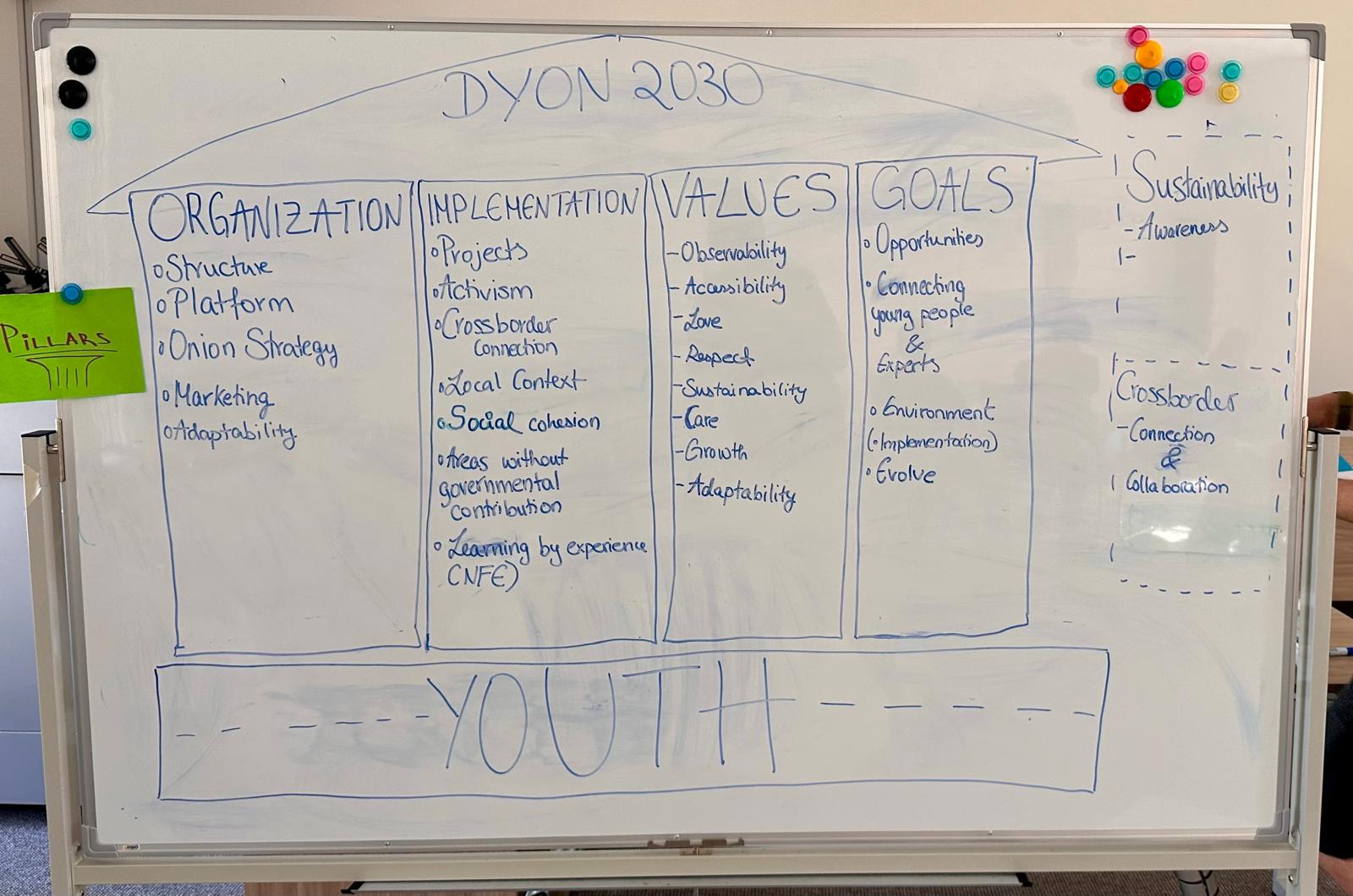
At the whiteboard, the group condensed all this into a single image. DYON 2030 is drawn as a house, with Youth as its foundation and four pillars. Organisation: structure, platform, marketing, adaptability. Implementation: projects, activism, cross-border connections, social cohesion, learning by experience and, explicitly, work in regions without state support. Values: visibility, accessibility, respect, sustainability, care, growth and – unabashedly – love! Goals: creating opportunities, connecting young people with experts, the environment, further development. Sustainability and cross-border cooperation stand alongside as cross-cutting themes.
Commitment Instead of Declarations of Intent
On the last day, the vision became a work plan. In responsibility tables, each group recorded exactly what happens first, who does it, by when, and what is needed for it. One team is preparing the third Boot Camp in 2027 and is starting with an honest evaluation of this year’s. By the end of October, the marketing team will launch an Instagram channel complete with a brand kit and posting schedule – in other words, with formats that explain DYON in the language of its own generation: the direct answer to the criticism of official jargon. A third group is setting up an FAQ page so that no one is held back by the simple question of whether accommodation and travel costs are covered. Another group is working on a flexible, self-organised system to secure staff and funding in the long term.
In the column “What do we need?”, the same three things keep coming up: time, people, determination. And in one place it is spelled out explicitly: funding from the European Commission, support from the EUSDR, and participating organisations from at least five DYON countries. This is exactly what will decide whether the names in the tables remain just names or turn into results.
Outlook
The next date is set: on 7 October, Bulgaria’s National EUSDR Coordinator, Vyara Mincheva, invited DYON to present its results at the meeting of the National Coordinators and Priority Area Coordinators (EUSDR NC-PAC Meeting) in Ruse, as it did the year before in Bosnia and Herzegovina. In November, the EUSDR Annual Forum follows in Sofia, explicitly open to all. In 2027, under the Croatian Presidency, the third DYON Boot Camp is set to take place.
The great European Jean Monnet, with whom Stefan Barth closed his presentation, put it this way: “Nothing is possible without people; nothing lasts without institutions.” In Bulgaria, both could be felt in honest symbiosis.
Mirella Sidro,
Sarajevo