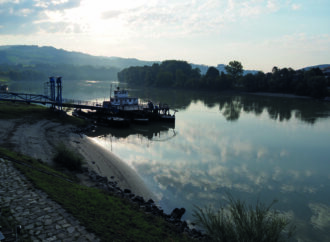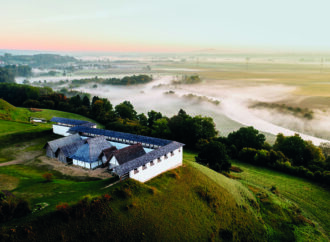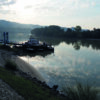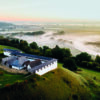

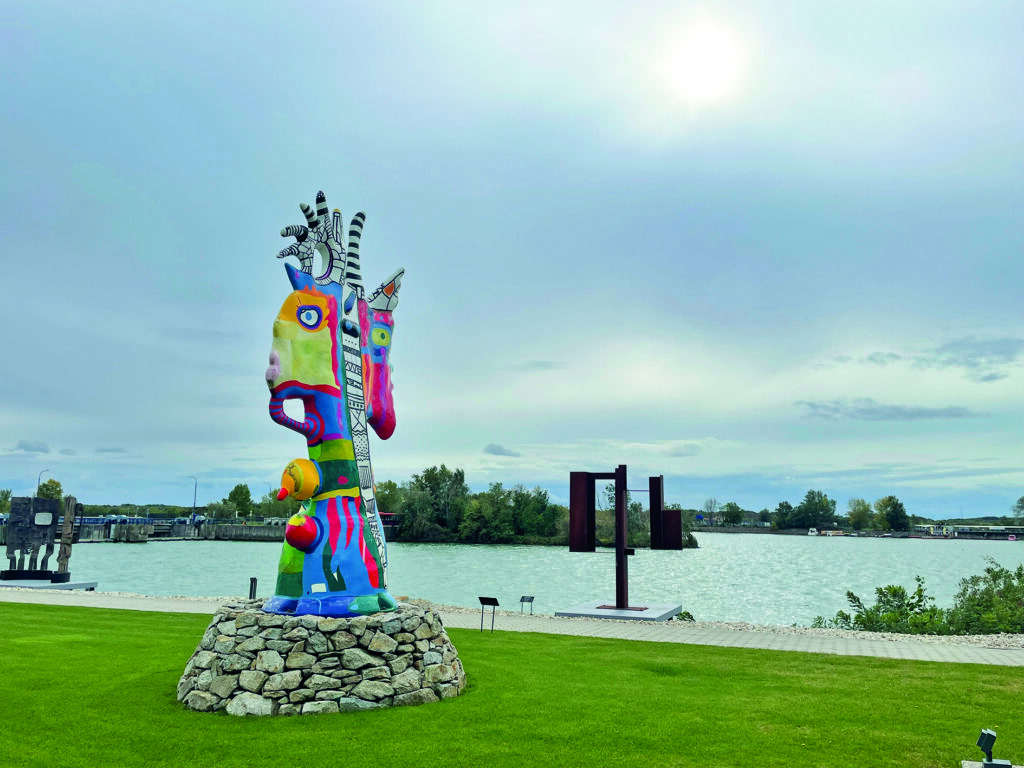
The setting is truly spectacular and quite unique: situated right in the middle of an artificial peninsula in the Danube – which is exceptionally wide at this point, within the reservoir area for the Gabcˇikovo Power Plant – lies the Danubiana Meulensteen Art Museum, showcasing international and Slovak paintings, sculptures, installations, and other artworks from
The setting is truly spectacular and quite unique: situated right in the middle of an artificial peninsula in the Danube – which is exceptionally wide at this point, within the reservoir area for the Gabcˇikovo Power Plant – lies the Danubiana Meulensteen Art Museum, showcasing international and Slovak paintings, sculptures, installations, and other artworks from the 20th and 21st centuries.
From Bratislava, about 20 kilometers away, you can easily get there by public bus. The bus stop is right in front of the museum, making the Danubiana part of the cultural landscape of the Slovak capital. The Hungarian and Austrian neighbors are, so to speak, within sight, which can be clearly seen from the museum’s walkable roof or from the glass-enclosed cafeteria. Danubiana is thus a very European museum, if only because of its geographical location in the Slovakia-Hungary-Austria border triangle.
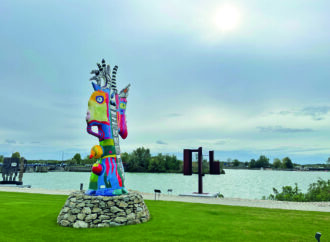
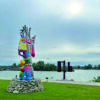
Lenka Krčmárová, who works in public relations at Danubiana, also highlights what makes this location so special. The museum’s sculpture garden “allows visitors to encounter works of art in a natural dialogue with the surrounding landscape.” And, one might add, especially with the Danube.
According to Lenka Krčmárová, the museum, which opened in September 2000, has since hosted over 300 exhibitions by international and Slovak artists—including works by Joan Miró, Sam Francis, Magdalena Abakanowicz, and others.
The museum was initiated by the Dutch entrepreneur, patron, and art collector Gerard Meulensteen (1943–2026). He first met the Slovak gallery owner Vincent Polakovič, who later became the director of Danubiana, in 1994. The idea for the museum emerged from this connection. The bright and transparent museum building, reminiscent of a beached ship, was designed by the Slovak architect Peter Žalman. In 2012, Meulensteen donated the museum to Slovakia.
Meulensteen loaned the collection he had built up—which included works by Claes Oldenburg, Christo, Corneille, Pierre Alechinsky, Magdalena Abakanowicz, Paul Jenkins, Hans Van de Bovenkamp, and others – to the museum for 20 years. The approximately 200 sculptures and paintings in the collection are presented on a rotating basis. However, Danubiana has also been building its own collection, with a focus on contemporary Slovak art.
The upcoming special exhibitions, running from April/May 2026 through January 2027, will feature everything from photography and sculpture to painting and mixed-media projects. “Mirror of a Shattered World” is the title of the exhibition, on view through the end of May 2026, featuring works by Czech artist Petr Pavlik.
Abstract works by the Slovak modernist Alojz Klimo will be on view from April through mid-June. Additional exhibitions will feature works by the Czech artist Lubomír Typlt, the Slovak artist Patrícia Koyšová, as well as Milan Bočkay and Svetozár Ilavsk – both also from Slovakia.
When drawing a European comparison to the Danubiana Museum, the Louisiana Museum just outside Copenhagen readily comes to mind. In both cases, the museum buildings and collections are seamlessly integrated into the landscape. And the waterfront location plays a major role: the Öresund there, the Danube here.
The Danubiana has no reason to shy away from this comparison. Visitors automatically engage with the river, the Danube. Amidst the flow of the river, one encounters a wide spectrum of contemporary, highly intriguing art. It is a Danube experience quite unlike any other.
Bernd Weltin,
Ulm
Danubiana Meulensteen Art Museum
Hours: 10:00 am – 6:00 pm
Closed Mondays
Last admission at 5:30 pm