
Five years ago, UNESCO designated the world’s first biosphere reserve spanning five countries along the Mura, Drava and Danube: Austria, Slovenia, Croatia, Hungary and Serbia. In September 2026, WWF Austria invited journalists from five countries on a trip to present LIFE RESTORE for MDD (Mura-Drava-Danube). It is a project that shows that nature knows no
Five years ago, UNESCO designated the world’s first biosphere reserve spanning five countries along the Mura, Drava and Danube: Austria, Slovenia, Croatia, Hungary and Serbia. In September 2026, WWF Austria invited journalists from five countries on a trip to present LIFE RESTORE for MDD (Mura-Drava-Danube). It is a project that shows that nature knows no borders – instead, it unites people in the shared fight for Mother Earth.
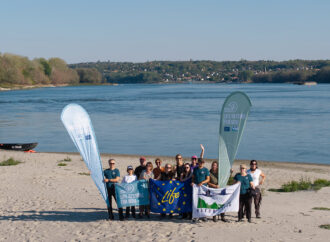
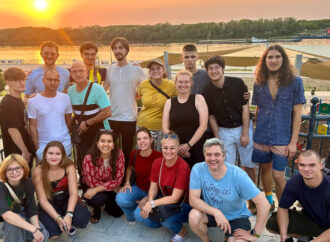
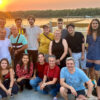
From 13 to 17 September, danube connects, together with colleagues from Austria, Slovenia, Croatia and Hungary, visited construction sites, floodplain forests and meadows where the EU project LIFE RESTORE for MDD is giving the rivers back some of their former dynamics.
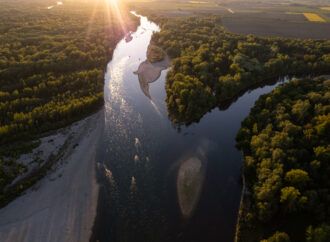
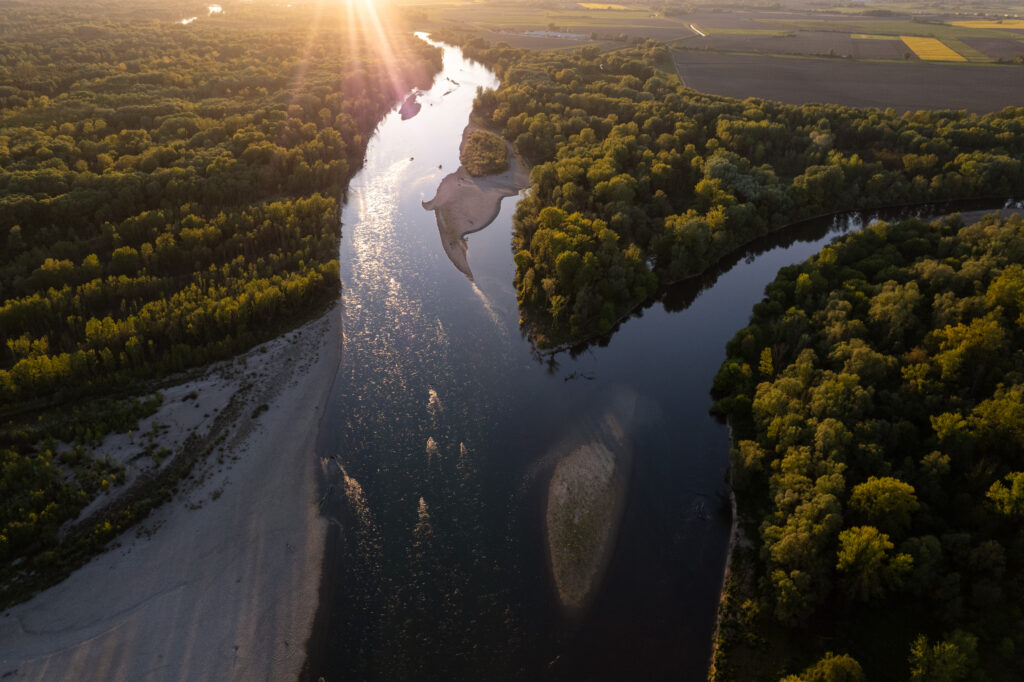
The UNESCO Mura-Drava-Danube Biosphere Reserve extends across Austria, Slovenia, Croatia, Hungary and Serbia. It protects rivers, floodplain forests, wetlands and the habitat of numerous endangered species. Because of its size and conservation value, it is known as the “Amazon of Europe”.
Yet it is precisely the largest contiguous floodplain forests of the Danube region that are in poor condition. Straightened rivers, intensive forestry, invasive species, an impoverished gene pool and a lack of cross-border cooperation are taking their toll. This is exactly where LIFE RESTORE for MDD comes in.
The principle is simple: the straighter a river, the faster the water drains away and the less of it seeps into the groundwater. Bends slow the water down and replenish the groundwater reserves. WWF’s goal is therefore to give the rivers back as much of their dynamics as possible.
The project runs from 1 October 2023 to 30 September 2028. It is being implemented by 17 partners from all five countries and coordinated by WWF Austria. The budget is around 20 million euros (EUR 20,024,000), 67 per cent of which is funded by the European Union’s LIFE programme. Measures are planned at 29 sites in 17 Natura 2000 areas covering a total of 2,100 square kilometres.
The goals in numbers:
- 336 hectares of floodplain forest will be restored.
- Side channels will be reconnected and riverbeds widened along some 54 kilometres.
- 966,000 cubic metres of sediment will be mobilised.
- International and regional cooperation is intended to reach around one million people.
Stop 1: Halbenrain, Styria – the Mura gets 450 metres of space
At the mouth of the Sulzbach stream in the municipality of Halbenrain, the Mura is being widened over a stretch of around 450 metres. Construction runs from April to December 2026. Representatives of the Province of Styria guided the group around the site, where the excavators were hard at work.
Until now, bank reinforcements have kept the river in its bed. These are now being removed along roughly 450 metres and relocated 30 to 50 metres inland as concealed groynes. There they protect neighbouring land and a planned maintenance path. In addition, a flow divider and an initial groyne are intended to set the river in motion.
From 1890 onwards, the Mura was forced into its present bed to protect the fields from flooding. 120 years ago, it was still 130 to 150 metres wide here. Today, sandbanks and side channels are missing, partly because hydropower plants on the upper course cut the river off from its floodplain. And yet new hydropower plants are still permitted in Austria.
In future, the river is to be allowed to shape itself. Gravel banks, scour pools and shallow-water zones will form where the Mura can once again shift material. In the Sulzbach itself, root stocks and hydraulic engineering stones create new structures, while deadwood adds further habitats.
Styria has been working on restoring the Mura for 24 years. In the long term, over the next 100 years, the river is to regain space for its original course. Today, 43 fish species live in the Mura, but they need structures such as gravel banks and shallow water to spawn. Sand martins also look for steep banks here to build their nests.
The goals for this section:
- improved water conditions for 4 hectares of floodplain forest
- a more natural shape across 1 hectare
- 30,000 cubic metres of mobilised sediment
- an ecologically continuous Sulzbach
Before construction began, reptiles were collected and relocated. Trees that might serve as bat roosts were sealed off and bat boxes put up. The measure follows the management plan for the Natura 2000 site “Südoststeirisches Hügelland” (South-East Styrian Hill Country). During planning, several hydraulic scenarios were modelled, from the current state to the river’s future development.
Stop 2: Hrastje-Mota, Slovenia – a river that has dug itself in
Barely an hour’s bus ride further on, near Hrastje-Mota in the municipality of Radenci, the damage done by river regulation becomes apparent. The Mura once flowed freely through its wide floodplain, repeatedly shifting its course. Today, its dynamics are confined to a narrow strip of floodplain forest right along the bank.
River regulation and hydropower plants on the upper course hold back gravel. The Mura carries less bedload, cuts deeper into its bed, and the groundwater table drops. The floodplain forests suffer as a result.
And this even though the Mura is Slovenia’s largest free-flowing river – there is not a single hydropower plant on Slovenian territory. It was straightened nonetheless. Most of the project’s restoration work takes place in Slovenia. Besides the banks, the forests themselves are being transformed and side channels and habitat types restored. A regional park is also being prepared as a protected area for the region.
The Slovenian Water Agency (Direkcija RS za vode) and the Institute of the Republic of Slovenia for Nature Conservation (ZRSVN) presented the work. Since early August 2026, the riverbed on the left bank has been widened near the ponds by the Gradišče fishing lodge. The Hrastje-Mota 2 section builds on the first widening (Hrastje-Mota 1) carried out under the predecessor project lifelineMDD.
The measures at a glance:
- Existing bank reinforcement will be removed along 320 metres, plus 130 metres of passive bank protection.
- New passive bank protection will be built along 470 metres, set back 15 to 85 metres inland.
- A replacement path will take the place of part of the existing forest road.
- Total area: 2.4 hectares; estimated cost around EUR 153,500 including VAT.
The riverbed is becoming wider, yet residents remain protected: the stones from the old bank reinforcement are being used to build a new protective embankment further back. In this way, the project protects both infrastructure and drinking water. “We do the big work, but the biggest work is done by the Mura itself,” said a representative of the Slovenian Water Agency.
The experts expect more natural river dynamics, a lower flood risk, rising groundwater levels, better drinking water and greater biodiversity. The area is part of the Natura 2000 sites Mura (SI5000010 and SI3000215) and, since 2021, of the five-country biosphere reserve.
A fisherman remembers
One of the fishermen who attended the visit has been fishing on the Mura for more than 50 years. 35 to 40 years ago, he recalls, many different fish species still lived here, and the Mura was considered the river with the greatest diversity of fish. Then stone blocks were placed along the banks and the riverbed was narrowed so that the water would drain away faster. Many fish migrated to Austria, and with them other species disappeared too – the flora and fauna of 50 years ago. Only when sewage treatment plants were built in Austria did many fish species return.
By then, however, the Mura had dug itself in, and the lower riverbed brought a new problem: the cormorant has settled here. Along five kilometres of riverbank, around 1,000 dead fish attributed to the bird were found.
The fisherman expects nothing but good from the restoration. As the river becomes wider again, he says, the habitat will regenerate. This will bring back more fish as well as other species. He estimates that the results will be visible in about five years.
Stop 3: Ižakovci, Slovenia – a birthday celebration on the Island of Love
On 14 September 2026, Mura Biosphere Reserve Day was celebrated on the Island of Love (Otok ljubezni) near Ižakovci, marking the fifth anniversary of the UNESCO designation. It was organised by the Slovenian nature conservation institute ZRSVN as part of LIFE RESTORE for MDD, together with the REVIVO institute.
In the morning, the island belonged to the children. Around 160 fifth-graders from local primary schools, accompanied by 15 mentors, explored the forest and water along the Mura and its animal and plant species. Those involved included fishing and boating clubs, forestry and water authorities, the butterfly society and the Slovenian bird protection organisation.
The day is celebrated every year, with activities lasting until midnight. Only around 5 per cent of Europe’s rivers are still alive, speakers said, which makes the Mura all the more valuable. 16 municipalities are involved in the project.
The “Mura dragon” returns
The highlight for the journalists was the release of young sterlets. The sterlet belongs to the sturgeon family, an evolutionarily ancient group of fish, and is endangered in the Danube basin. Because of its primeval appearance, it is known locally as the “Mura dragon”.
REVIVO released the fish as part of the LIFE-Boat4Sturgeon project. In the long term, a self-sustaining sterlet population is to be re-established in the Slovenian section of the Mura.
That is the aim of the project. Sturgeons recognise the waters in which they were born and return there to spawn. That is why the young fish were raised in water from the Mura.
For us at danube connects, this moment was the highlight of the entire trip: we were allowed to release a baby sturgeon ourselves. We are big fans of these fish, which have become so rare in Europe. Holding such a small creature in our hands, letting it slip into the water and watching it swim off into the distance moved us deeply.
We wish the little water dragon a safe return in a few years’ time to spawn here, so that the population grows and the Mura becomes once again what it once was: a natural habitat for sturgeons.
A floodplain forest with a future
After a short walk from the Island of Love, representatives of Slovenian State Forests (SiDG) showed how they are transforming the floodplain forest. Non-native and invasive trees such as hybrid poplar and box elder are gradually being replaced by typical species. In the softwood floodplain, these are mainly white willow, black poplar, white poplar and black alder; in the hardwood floodplain, pedunculate oak, hornbeam and wild cherry.
The saplings come from certified nurseries. Tree shelters or fences protect them from game, and the areas are mown once or twice a year. In total, 10 hectares of softwood floodplain and 9 hectares of hardwood floodplain are to be restored, spread across sites between Ižakovci, Mota, Murska šuma and Razkrižje.
One unusual element is a trial with pigs. They are meant to loosen the soil so that acorns germinate more easily and young oaks can regenerate naturally.
The oaks themselves show how urgent this is: many have died because the floodplain has become too dry. It is important, the foresters said, to bring back not only the forest but also its tree structures as habitat.
Stop 4: Donje Međimurje, Croatia – meadows for two rare blue butterflies
On the second day, the trip took us to Croatia, to the area around Hodošan. In the Natura 2000 site Donje Međimurje, in the eastern lowlands of Međimurje County between the Kopanec and Trnava streams, the focus is not on forest but on meadows. The area is part of the Mura-Drava Regional Park.
Monika Cindrić and Ivana Horvat from the nature conservation agency Međimurska priroda presented the project, which is now in its third year. At its heart are two butterflies threatened with extinction: the scarce large blue and the dusky large blue (Phengaris teleius and Phengaris nausithous). In Croatia, they now occur at only four sites.
Their lives depend on a single plant, the great burnet, and on ants. They are the cuckoos of the insect world: the caterpillars trick ants into carrying them into their nest, where they are fed and cared for.
The threat of extinction came to light when an expert noticed that only a single population remained. In the past, people kept the meadows open as a matter of course: they mowed them for hay, grazed livestock and gathered wood for the winter. Today, meadows are ploughed up or become overgrown with shrubs and invasive species.
The conservation agency is therefore buying meadows itself – 4 hectares in total. It removes trees, shrubs and invasive species, re-sows meadow seed on ploughed land and mows partly by hand, in line with the butterflies’ needs. Once a year, the areas have to be cleared of bushes. By September 2028, a mosaic of lowland hay meadows and hedgerows is to emerge, with new migration corridors for the butterflies. The strictly protected snake’s head fritillary also grows here.
Here, too, we were able to lend a hand and sow grass seed. We hope that one day it will grow into a habitat for the two butterflies that have found their home here and that people are trying to save by every means possible.
The butterfly is merely a flagship, the two conservationists revealed. Here, Natura 2000 protects many other insect and animal species as well.
Stopover: the steep bank at Libanovec – the village of the sand martins
At the steep bank of Libanovec, the Drava is allowed to flow as it pleases: there are neither hydropower plants nor dams on this stretch. “The river is a living organism,” said Arno Mohl of WWF Austria. In the 1980s, he said, people tried to control it, and it did not work.
The little ringed plover breeds on the sandbanks. Its eggs are almost invisible, which is why visitors should not walk on the banks. The stretch is also a paradise for fish. But it is famous above all for the sand martin, the smallest swallow species here. The colony on the steep bank at Libanovec is one of the largest on the Croatian section of the Drava. In good years, more than 1,000 pairs breed here. Sand martins need free-flowing rivers whose banks collapse at the bends – only then can they dig new nesting burrows into the sand every year.
Libanovec belongs to the municipality of Đelekovec. In June 2024, it became the first village in Croatia to receive the honorary title “Village of the Sand Martins”. The initiative came from former mayor Štefica Sirutka and was supported by the DRAVA LIFE project. The municipality reached an agreement with farmer Jasna Puhar (OPG Puhar), who farms the land next to the colony: the bank is allowed to erode naturally into her field, and in return her lease was reduced.
The title was accepted by Mayor Lara Samošćanec. She is Croatia’s youngest mayor, first elected at the age of 22. “This little bird is our inspiration,” she said. Exhibitions and events revolve around the swallow, which connects nature and people.
Meeting this young mayor was one of the most beautiful encounters of the trip. She protects the sand martins with great enthusiasm. She is opening up the village to visitors who want to connect with nature, while making sure that no one disturbs the birds’ way of life.
She shows what is needed: young people with new ideas, and more women in positions of responsibility. We can learn a great deal from village communities like this one, which have lived in harmony with nature for centuries.
Stop 5: The confluence of the Mura and Drava
Near Legrad in Koprivnica-Križevci County, right on the border with Hungary, the Mura and Drava flow together. The Mura is brown, the Drava green. It was fascinating to see. And we were lucky: the sun was shining, so the contrast was especially clear.
Even the Romans regulated both rivers, as large stones still bear witness. Today, the confluence is a nationally and internationally protected area: it lies within the Mura-Drava Regional Park, the Veliki Pažut Ornithological Reserve and the biosphere reserve. The county has 15 Natura 2000 sites. Its task: to protect, manage and raise awareness. Its location on the border is an advantage, as protection always needs both sides.
Here, the project focuses on native floodplain forests and invasive plants. First, the introduced species were mapped across the entire area. Then 10 priority sites were selected, where they have been removed since July 2025. By September 2028, around 20 hectares of softwood floodplain are to be maintained in good condition in this way.
The main adversaries are false indigo, goldenrods, common ragweed and Japanese knotweed. They are pulled out by hand, mown and cut back, or mulched by tractor. A follow-up study has determined the right method and timing for each species and each site. It also recommends informing the public about the consequences of invasive species.
Why rivers need our protection
danube connects has been focusing on rivers for many years, because hardly any other habitat is as threatened. According to the WWF Living Planet Report 2024, monitored populations of freshwater species have declined by an average of 85 per cent since 1970. Worldwide, only 37 per cent of the longest rivers still flow freely; the rest are fragmented by dams and reservoirs.
Rivers must therefore be given special protection – because of their flora and fauna, but also because we humans cannot live without water. Europe is rich in rivers. We must protect, respect and preserve those we still have, not only for our generation but also for those to come.
Those were the first days of our journey through the “Amazon of Europe”. In Part 2, we continue to the Danube.
Mirella Sidro,
Sarajevo