
On the third and fourth days of the WWF press trip, the journey leads from a reopened side channel of the Drava through the floodplains of Kopački Rit in Croatia to the tri-border area near Batina and the oxbow lake at Báta in Hungary. Everywhere we go, we encounter the same question: what becomes of
On the third and fourth days of the WWF press trip, the journey leads from a reopened side channel of the Drava through the floodplains of Kopački Rit in Croatia to the tri-border area near Batina and the oxbow lake at Báta in Hungary. Everywhere we go, we encounter the same question: what becomes of a river landscape when it runs out of water?
Late summer 2026 is the third dry one in a row. Water levels on the Drava and Danube are among the four lowest since records began. Jasmin Sadiković grew up on the Drava. He says he has never experienced a drought like this in his 52 years.
The shortage is not only a matter of climate. Upstream, in Austria and Slovenia, hydropower plants hold back water and sediment. Downstream in Croatia and Hungary, both are lacking: the rivers dig deeper into their beds, groundwater levels fall and the floodplain forests dry out. This is exactly where the EU project LIFE RESTORE for MDD comes in, restoring river floodplains at 29 sites in five countries between 2023 and 2028.
Stop 6: Novačka – a side channel gets its water back
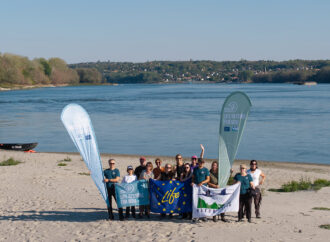
Wednesday, 16 September, 8:30 a.m. After breakfast in Legrad, the bus takes us to Novačka, a village in the municipality of Gola in Koprivnica-Križevci County. Here, at river kilometres 214 to 217, lies one of seven restoration sites of the DRAVA LIFE project. It was jointly run by the Croatian water management authority (Hrvatske vode), WWF Austria and the nature conservation organisation Green Osijek. The project began in December 2015 and, after an extension, ran until November 2024.
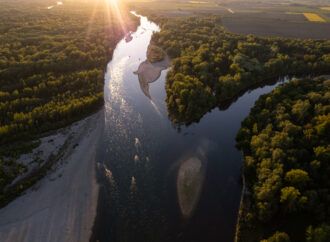
The idea is simple: an old side channel on the left bank, around 1.2 kilometres long, had silted up at its inlet. Excavators removed about 100 metres of sediment, and since then the Drava has been flowing into it again. Opposite, on the right bank near Gabajeva Greda, a new so-called “initial channel” was opened: almost 1,200 metres long and up to 27 metres wide. The river does the rest itself. With each flood, the channel is expected to settle into a naturally meandering shape.
Dynamic rivers have bends, known as meanders. These give rise to sand and gravel banks and steep banks that provide habitat for endangered species such as the little tern or the almost extinct German tamarisk. At the same time, the river gains more space. This relieves the pressure on dams and villages downstream without the need to raise the dykes.
On site, Maja Mlinarić Bajsić and Tomislav Šlehta from Hrvatske vode explain how hydraulic engineering and nature conservation work together here. One lesson from years of resistance to new dams on the Drava: stopping a hydropower plant is difficult. But you can make it unattractive. Since the Drava became part of the Natura 2000 network, a power plant there hardly pays off financially any more. And anyone who opposes a power plant should always put a worthwhile alternative on the table.
Stop 7: By boat to the confluence – the Bjelobrdska oxbow
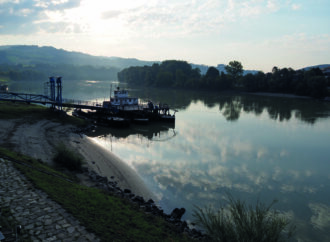
We had been looking forward to this afternoon from the very start. After days on land, we are finally out on the water. In Osijek we board the boat, the sun is shining, and the Drava carries us towards the Danube. The trip is incredibly beautiful.
Along the way, representatives of Green Osijek, Hrvatske vode and the Faculty of Agrobiotechnical Sciences Osijek explain what is happening along the banks.
On the right bank, just before the confluence, lies the Bjelobrdska oxbow. It is the remnant of a Drava meander that was cut off at the beginning of the 19th century, when a new, straight riverbed was dug in 1805 and 1807. Today it is part of the Mura-Drava Regional Park, two Natura 2000 sites and the biosphere reserve.
Its condition is critical. In times of drought, up to 40 per cent of the oxbow dries up, and in the rest the water is only 20 to 40 centimetres deep. The lake is over-fertilised, plants are growing rampant, oxygen is running short, and there have been fish kills.
With 3.2 million euros, this is set to change by September 2027. Around 200,000 cubic metres of sediment will be dredged and reused elsewhere. The barrier to the Malo Renovo canal will be opened so that water from the Drava can once again flow towards the Danube through 5.5 kilometres of oxbow and ten kilometres through Aljmaški Rit. 193 hectares of floodplain forest are set to benefit.
The faculty’s survey shows how much life is still here: 128 species of vascular plants and 60 bird species – around 16 per cent of all those found in Croatia – including five species of woodpecker, as well as otters and beavers, European pond turtles, red deer and golden jackals.
Then the view opens up. The Drava flows into the Danube, and suddenly everything is vast and wide. We feel the energy of this great river, an ancient energy. Since time immemorial, the Danube has connected peoples, cultures and customs. All the sadder, then, to see how much it has been changed by human intervention – ultimately to the detriment of people themselves.
Kopački Rit: When the Rit calls you
We spend the night at the Zlatna Greda eco-centre, in the middle of Kopački Rit Nature Park. The wetland between the Drava and the Danube covers around 23,000 hectares and is one of the best-preserved river floodplains in Europe. Almost 300 bird species have been recorded here, about 80 per cent of all those found in Croatia. Normally, the water level fluctuates by five to seven metres over the year. This late summer, we mostly see dry ground.
Zlatna Greda is a wonderful place to stay, surrounded by nature. As soon as darkness falls, we hear the roaring of the stags and the howling of the wolves. And then that starry sky – one you never forget.
One of the rangers sums up his relationship with this landscape in a single sentence: “You go into the Rit when it calls you, and home when it lets you go.”
Jasmin Sadiković heads Green Osijek and coordinates LIFE RESTORE for MDD in Croatia. The ecologist has been working in the biosphere reserve for more than 25 years. “I feel like a child in Peter Pan,” he says. “I’m living my childhood dream.”
Green Osijek wants to bring people closer to nature. To this end, the organisation works with hunters and fishermen rather than against them. Together with schools, it develops games and activities in which children reflect on the future and on protecting nature. Project manager Nikolina Stjepanović oversees this environmental education programme, which is shared across all five countries of the biosphere reserve.
Batina: Where the Danube connects again
Thursday, 17 September. From the Victory Monument above Batina, you look out over the tri-border area: Croatia, Serbia opposite, Hungary not far away. Here too, the Danube is very low.
The place has a difficult history. In November 1944, the Red Army and Yugoslav partisans fought the German Wehrmacht here. The Danube, people say, ran red. During the wars of the 1990s, many young Serbs left Croatia for Sombor on the other side of the river. For about 15 years now, people have been working together again. “Through the Danube, we are becoming friends again,” says Radmila Šakić Peurača.
Peurača, from the state forestry enterprise Vojvodinašume, which is responsible for the Gornje Podunavlje Special Nature Reserve, reports from the Serbian side. Canals have been built there that fill up when the Danube is high enough. They supply around 900 hectares of different ecosystems on state land. The forestry enterprise has a dual role: it preserves the forest and uses it at the same time.
Native ash and oak trees have been planted on 26 hectares; which species depends on the soil. Because the area is officially a hunting ground, new plantings remain fenced off for 20 years so that game cannot eat them. The young trees are tended for two years and then left to nature.
But the groundwater is sinking. This year it reached a historic low in the village, and the foresters are having to switch to other tree species. And the solution? “We don’t know it.”
Stop 8: Báta – an oxbow and two pillars with a history
Around midday we reach Báta in Hungary. The oxbow here is one of the largest dead arms of the Danube in Duna-Dráva National Park, around ten to twelve kilometres long and about ten metres wide. Before regulation, it was the Danube’s main channel. Afterwards, the river flowed straighter and faster, dug itself deeper, and the old arm silted up.
Here too, water is lacking. Sedimentation, the deepening of the riverbed and climate change have greatly reduced the inflow. One cause lies far upstream: the hydropower plants in Austria hold back the bedload, so hardly any sediment reaches Hungary. And when the water is low, it cannot deposit any either.
For us, this is the most shocking moment of the trip. In places, there is no water at all left in the old Danube bed. Where the main river once flowed, there is now dry ground. One hates to imagine that this could be a picture of our future if we do not change the way we live.
Tibor Parrag and Sándor Kövesi from the national park directorate explain what is planned. Across some 85 hectares, a low dam will be built to impound the upper part of the oxbow. About 8,000 cubic metres of sediment will be dredged so that open water areas remain permanently, and the existing sluice will be renewed. Planning and environmental assessment took place in 2025; construction begins in 2027.
The dam will be built at a site with a history. Two large pillars stand there, intended in the 1950s for a railway bridge. The bridge was never built – tensions with what was then Yugoslavia got in the way. Today the pillars are a stroke of luck: they are so sturdy that the floodwater surging into the oxbow with great force cannot knock them over.
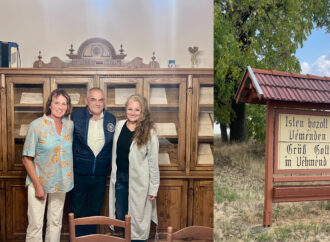
The national park staff do not rely solely on prohibitions. The municipality is to be involved, and so are the fishermen. József Bocz, deputy mayor and chairman of the local angling club, has known the oxbow for decades. The restoration had been planned for a long time, but there was no budget. Experience is encouraging: once the water is there, the new habitats become visible as early as the second year.
A farewell full of gratitude
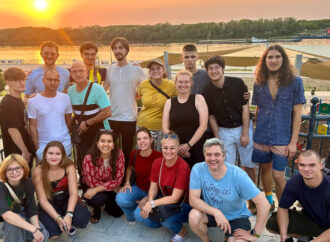
In the afternoon, the bus heads back to Vienna, while the Hungarian participants travel to Budapest and the Croatian ones to Zagreb. Four days, eight stops, five countries.
We take one insight home with us. It has often been said, but it cannot be said often enough: it is of little use if one country looks after its river and the next one does not. What happens upstream arrives downstream. Saving the Mura, Drava and Danube does not depend on any single state. We have to think across borders and switch off the borders in our minds.
Rivers need space, bends and, above all, water. Where they are given these back, life returns astonishingly quickly. Where the water stays away, even experienced foresters are at a loss.
We thank WWF for this trip. It was one of the most extensive we have ever undertaken, and at the same time one of the most valuable. We at danube connects would like to see more trips like this. On them, you not only return to your roots as a human being – to Mother Nature – but also learn what state she is in and what can be done to give her back her natural habitats.
Mirella Sidro,
Sarajevo