
In Freiburg, there is an institute that studies the lives of Germans in Eastern Europe: the Institute for Cultural Analysis of Germans in Eastern Europe (IKDE). Researchers there have delved into the archives and unearthed photographs and audio recordings of childhoods and youth along the Danube. Together with partners from the Danube countries, this has
In Freiburg, there is an institute that studies the lives of Germans in Eastern Europe: the Institute for Cultural Analysis of Germans in Eastern Europe (IKDE). Researchers there have delved into the archives and unearthed photographs and audio recordings of childhoods and youth along the Danube. Together with partners from the Danube countries, this has resulted in a moving exhibition.
Ms. Wirschke, as the project coordinator for the exhibition, what stories about childhood and youth in the Danube region do we encounter in the exhibition? Which ones do you particularly like?
The photograph showing a group sitting together, husking corn. It comes from an estate in our Freiburg archive (Institute for Cultural Analysis of Germans in Eastern Europe). From this estate, we also have audio recordings of the corn harvest in Dobruja (Romania) and Bessarabia (Ukraine). On the one hand, you hear that young people also had to help out. Until late into the night. At the same time, it was always a real celebration. The wine flowed and the young people were able to get to know one another. So, a little breathing space… Maize was very important to agriculture in these regions. At the same time, it was also used to make toys.
Toys?
Yes, dolls, for example! I also loved a photo of some children picking mush-rooms: a boy is looking mischievously at the camera, holding a parasol. The photo was taken in the 1930s in Slovakia. There was a German minority there – and a story behind the photo. The young people had a long way to school – all the way to Kremnitz (today Kremnica). The field in front of which the boy is standing was called ‘Die volle Henne’ (the full hen). He used to go there after school with his friends to go mushroom picking. His mother would then sell them at the market for two crowns. That was enough for him to pay the entrance fee to a dance.
Was there anything in the exhibition that shocked you or made you feel sad?
The exhibition also addresses the deportations carried out under the Stalinist regime. A photograph from the National Museum of the History of Moldova shows schoolchildren with their teacher. Some of the children were deported from what is now the Republic of Moldova to Siberia. They are holding books in their hands bearing the words ‘mother tongue’ – written in Russian. One can view this in different ways: on the one hand, it was not the children’s mother tongue – on the other hand, it was important for them to learn the language in order to integrate there and build a life for themselves. I was also moved by a photograph of orphans. They were extremely emaciated, lined up in rows, with toys in the middle. Some of them were military toys. From 1946 to 1947, there was a great famine in the Soviet Union, which hit the Moldavian SSR and children, as a vulnerable group, particularly hard. Contrary to the propaganda, the Soviet state did not protect its citizens and children, but instead exacerbated the famine and used it as an instrument of repression.
Is the exhibition mainly about childhoods and youth in the past?
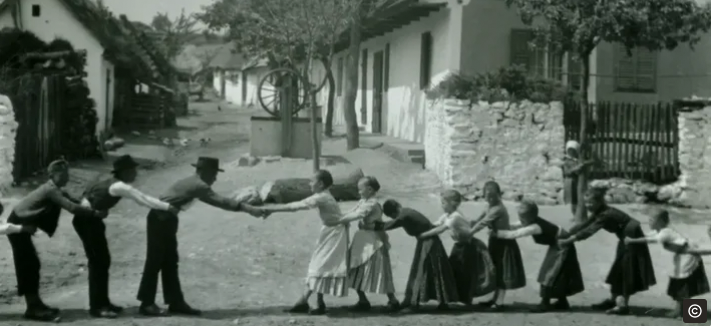
Yes, we mainly display photographs from the first half of the 20th century. This allows visitors to learn about the past. At the same time, the photographs remind them of their own childhood experiences.
Apart from the photographs, how else do visitors engage with the different stories in the exhibition?
There are short texts to read, audio recordings, regional artefacts and, as always, questions for visitors. These are designed to encourage them to reflect on the childhoods and upbringings of others, as well as their own. The first section of the exhibition is entitled ‘Belonging, Bonds & Beginnings’. It explores the social conditions and networks within which children grew up. What was the start of their lives like? What values were instilled? What role did friendships, family ties and work play? The second part explores how children come to terms with their environment. How they discover it through play. It focuses on places such as the family home, school, neighbourhoods and playgrounds. Questions for visitors include: Which objects, smells or images do you associate with your childhood? Which rules applied to the spaces you used yourself? The third part explores experiences and events that shape our memories – or that were not addressed, perhaps even repressed.
An example?
A photograph shows young people in what was then Romania, now the Republic of Moldova. In 1940, they were active in the anti-Soviet youth organisation ‘Majadahonda’; they were exposed in 1941 and were subsequently sentenced to death or sent to the Gulag. The photograph was taken during their school days. Other memories and traditions are less sombre, such as mining in the eastern Slovakian region of Spiš, where German minorities also lived for a long time, and the customs associated with it. At the miners’ festival in Göllnitz, there was a parade through the village accompanied by brass band music. The men wore traditional costume – the boys were dressed as little miners.
Is the exhibition aimed more at adults or children?
Both. It’s very straightforward and accessible. It’s a great place to take children – though it wasn’t designed specifically for them. In addition to the exhibition, there’s also our podcast ‘History in its Infancy – Growing Up in the Danube Region’, which explores the subject in greater depth. One episode, for example, deals with the memories of a family in the former Dobruja – a region in Romania where many different minorities lived together. Another focuses on the memories of German families who remained in the former Czechoslovakia or were expelled. There, we looked at three generations. We also visited the Danube Swabian Central Museum in Ulm. There are also in-depth digital learning resources on various topics available online.
The exhibition “Everyday Danube” was on display in Osijek, Croatia, until 24 April; from 15 April until 31 August (provisionally), it will be on display in Bratislava, Slovakia, and from 9 June to 30 July 2026 in Chisinau, Moldova. It was organised by the Freiburg Institute for Cultural Analysis of Germans in Eastern Europe (IKDE). In cooperation with: the Institute of Ethnology at the Academy of Sciences of the Czech Republic, Brno, Czech Republic; ILEU e. V. – Institute for Virtual and Real Learning in Adult Education, Ulm, Germany; the Institute of Ethnology and Central European and Balkan Studies at the Faculty of Arts of Charles University in Prague, Prague, Czech Republic; Museum of Slavonia, Osijek, Republic of Croatia, National Museum of the History of Moldova – Museum of the Victims of Deportations and Political Repression, Chisinau, Republic of Moldova, Slovak National Museum – Museum of the Culture of the Carpathian Germans, Bratislava, Slovak Republic.
The project is funded by the Baden-Württemberg Foundation as part of the Danube Perspective program.
Isabella Hafner, Ulm